

From 2001: A Space Odyssey (1968) to Blade Runner 2049 (2017), here are the best movies like Dune – films that share its ambition, its scale, and its conviction that science fiction is a serious form of art.
(This article was first published in 2024 and was updated on July 10, 2026) Frank Herbert published Dune in 1965. For the next five decades, Hollywood treated it as unfilmable. The novel’s intermesh of politics, ecology, religion, and psychology was too dense, its world too elaborate, its ideas too large. David Lynch tried in 1984 and produced something fascinating and genuinely strange: a cult object rather than a successful adaptation. Denis Villeneuve finally cracked it in 2021 and completed his two-part adaptation with Dune: Part Two in 2024, a film critics compared to the greatest sequels ever made.
And now, with the second trailer for Dune: Part Three dropping this week at a global IMAX fan event simulcast across eight cities, the end of Villeneuve’s trilogy is very much in sight. Adapting Herbert’s second novel Dune Messiah and set 17 years after the events of Part Two, the film arrives in theatres worldwide on December 18, 2026. Timothée Chalamet, Zendaya, Florence Pugh, and Jason Momoa all return, with Robert Pattinson joining as the villain Scytale.
Which makes this the right moment to revisit the films that share Dune’s ambition: the ones that influenced it and the ones it influenced, and the ones that occupy the same rare territory.
Quickly then, here are 17 must-see movies like Dune – plus one more that shares its DNA but we’d stop short of recommending.
Movies Like Dune
1. 2001: A Space Odyssey (1968)

The film Villeneuve has cited more than any other as an influence on his approach to Dune. Stanley Kubrick’s epic, a journey to Jupiter following the discovery of a mysterious monolith, established the template for serious science fiction cinema: vast scale, deliberate pacing, ideas given visual form rather than explained in dialogue. 2001: A Space Odyssey‘s exploration of evolution, artificial intelligence, and human consciousness remains the benchmark against which every ambitious sci-fi film is measured.
The specific connection to Dune is telling the story visually. Both films trust silence. Both understand that the largest ideas in science fiction: what humanity is, where it is going, cannot be spoken. They have to be shown.
Where to watch: Prime Video, Apple TV
2. Stalker (1979)

The closest spiritual relative to Dune is Andrei Tarkovsky’s Stalker. Based on the Strugatsky brothers’ novel Roadside Picnic, it follows a guide who leads two men through a mysterious restricted zone toward a room that supposedly grants wishes. Like Dune, it is a journey through hostile, almost sentient landscape. Like Dune, it is less interested in the destination than in what the journey reveals about the people making it.
Tarkovsky shoots the Zone the way Villeneuve shoots Arrakis, as a place with its own consciousness, indifferent to human survival and human meaning.
Where to watch: YouTube (free), Internet Archive
3. Solaris (1972)

Based on Stanisław Lem’s novel, this is science fiction as philosophical investigation rather than adventure. In Andrei Tarkovsky’s Solaris, a psychologist travels to a space station orbiting the planet Solaris to investigate why its crew has become dysfunctional, and finds himself experiencing the same psychological disturbances. Solaris, like the spice in Dune, does something to human consciousness that cannot be fully explained or controlled.
The film’s central argument, that alien intelligence may be so different from human intelligence that genuine communication is impossible, resonates directly with Dune‘s treatment of the Fremen and the Bene Gesserit.
Where to watch: YouTube
4. Blade Runner 2049 (2017)

The most direct bridge to Villeneuve’s Dune, made by the same director, shot by the same cinematographer Roger Deakins, with the same visual philosophy and the same patient, grounded approach to world-building is Blade Runner 2049. Set thirty years after the original, it follows a replicant detective whose investigation of a long-buried secret threatens to destabilise what remains of human society.
Like Dune, it is a film about what it means to be human in a world structured by power, exploitation, and manufactured identity. Blade Runner 2049 stars Harrison Ford, Ryan Gosling, and Ana de Armas in career-defining performances.
Where to watch: Netflix, Prime Video
5. Lawrence of Arabia (1962)

Frank Herbert drew on T.E. Lawrence’s memoir Seven Pillars of Wisdom when creating Paul Atreides. Villeneuve, in turn, has cited Lawrence of Arabia (1962) as a primary visual reference for Dune. The story of the British diplomat who united Arab tribes against the Ottoman Empire shares Dune‘s central tensions: the outsider who becomes a messiah, the question of whether that transformation is heroic or catastrophic, the landscape as both enemy and ally.
David Lean’s film is also where Villeneuve learned how to shoot desert. The framing, the scale, the relationship between the human figure and the vastness of the terrain – all of it is directly visible in Dune.
Where to watch: YouTube (free)
6. Interstellar (2014)

A group of astronauts travel through a wormhole in search of a new home for humanity as Earth becomes uninhabitable. Developed with physicist Kip Thorne, Christopher Nolan’s Interstellar combines rigorous scientific ideas with a human drama of love, loss, and survival that gives the science emotional stakes.
The specific connection to Dune: both films treat time as a resource, a weapon, and a mystery. Both understand that the most terrifying aspect of the universe is not its hostility but its indifference.
Where to watch: JioHotstar, Prime Video
7. Jodorowsky’s Dune (2013)

This documentary is essential viewing for any Dune fan. In the 1970s, Chilean filmmaker Alejandro Jodorowsky assembled what may have been the most extraordinary creative team in cinema history (H.R. Giger, Salvador Dalí, Mick Jagger, Dan O’Bannon, Chris Foss) to adapt Herbert’s novel. The film was never made. The documentary by Frank Pavich reconstructs what it might have been, using storyboards and interviews with the surviving collaborators.
The storyboards that Jodorowsky’s team created were circulated so widely in Hollywood that they directly influenced the visual language of Star Wars, Alien, and Flash Gordon. The Dune that was never made shaped science fiction cinema more profoundly than most films that were.
Where to watch: Apple TV, Prime Video
8. Mad Max: Fury Road (2015)

George Miller’s post-apocalyptic action film set in a desert wasteland, a world where resources have been exhausted and power belongs to whoever controls what remains. Max (Tom Hardy) joins forces with Furiosa (Charlize Theron) to escape a cult leader and his army.
The connection to Dune is in the structure: both are stories about resource control, ecological collapse, and the violence that both produces and is produced by scarcity. Both understand that the desert is not a backdrop but an argument.
The film is also a masterclass in action filmmaking. Practical stunt work, visual effects, and a chase sequence that runs for nearly two hours without losing its momentum.
Where to watch: Prime Video, JioHotstar
9. Avatar (2009)

Set in 2154, when humans are mining a moon called Pandora for a valuable mineral, Avatar follows a soldier who infiltrates the indigenous Na’vi through a biological avatar and finds himself choosing between his mission and the people he was sent to surveil.
The parallels with Dune are direct. Both feature a hero from a colonising power who joins the indigenous people, falls in love with a local woman, and fulfils an ancient prophecy. Both use spectacular world-building to make an anti-imperialist argument.
James Cameron had to develop entirely new technology to make the film. The result, particularly in 3D, remains one of the most immersive visual experiences in mainstream cinema.
Where to watch: JioHotstar
10. The Martian (2015)

An astronaut stranded on Mars after being accidentally left behind must survive until rescue arrives. Ridley Scott’s adaptation of Andy Weir’s novel The Martian is science fiction at its most grounded. The drama comes from problem-solving rather than spectacle, and the humor that emerges from the gap between the scale of the situation and the practicality of the response is one of its genuine pleasures.
Where Dune is operatic, The Martian is procedural. But both share an underlying argument: that human intelligence and human adaptability, properly applied, can survive almost anything.
Where to watch: JioHotstar, Netflix (outside India)
11. On the Silver Globe (1988)

Shot in 1977 and completed in 1988 after political interference halted production—a fact that is written all over the film and, strangely, adds to its power. A space researcher investigates a civilisation founded by astronauts stranded on a planet resembling Earth in Andrzej Żuławski’s film.
Based on Żuławski’s great-uncle Jerzy Żuławski’s novel, it is concerned with the foundation of civilisation, the emergence of religion, and the nature of humanity when stripped of its context. The film is demanding, visually extraordinary, and like nothing else in science fiction cinema. Its unfinished quality (restored footage narrated over missing scenes) makes it feel like a transmission from somewhere genuinely alien.
The film’s grand production design, mind-bending staging and philosophical musings intrigue as well as exhaust.
Where to watch: Internet Archive, YouTube
12. Ikarie XB-1 (1963)

A lesser-known Czech sci-fi film from director Jindřich Polák that was genuinely ahead of its time. Stanley Kubrick screened it during pre-production research for 2001: A Space Odyssey; its influence on that film’s approach to space travel is clearly visible. Set in 2163, a spaceship is sent to probe potentially habitable planets. The crew navigates isolation, psychological pressure, and a series of increasingly unsettling encounters.
Ikarie XB-1 is based on Stanisław Lem’s novel, The Magellanic Cloud. The film’s interest in the psycho-social dynamics of a crew under extreme conditions anticipates everything from 2001 to the Dune films’ interest in what prolonged exposure to an alien environment does to human consciousness.
Where to watch: Criterion
13. Fantastic Planet (1973)

An experimental animated science fiction film based on Stefan Wul’s novel Oms en série. The Draags are a large, blue-skinned, technologically advanced race that rule planet Ygam. They treat the humanoid Oms as natural inferiors, keeping them as pets or hunting them as vermin. When an Om receives an education, the power structure begins to shift.
The allegory of colonialism is identical to Dune‘s. And the film makes it with the surrealistic imagery of Roland Topor, which gives it a hallucinatory quality no live-action film could replicate. It is one of the most genuinely strange and visually inventive animated films ever made.
Where to watch: Prime Video
14. Star Wars: A New Hope (1977)
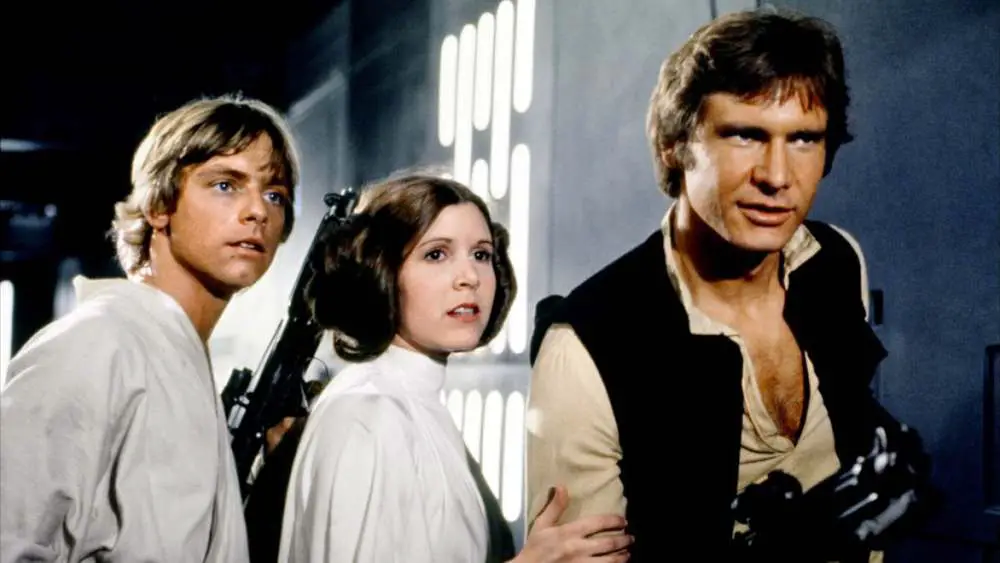
George Lucas has acknowledged Frank Herbert as a direct influence, and the debt is visible throughout the original trilogy. The desert planet, the chosen one narrative, the mystical energy field, the rebellion against an imperial power. The first film in particular established the blockbuster template that Villeneuve was consciously departing from with Dune.
Watching A New Hope alongside Dune is revealing. Both are hero’s journey narratives set in a galaxy-spanning conflict but where Lucas chose accessibility and optimism, Herbert and Villeneuve chose ambiguity and moral complexity.
Where to watch: JioHotstar
15. Kin-dza-dza! (1986)

A Soviet cult film in which two Russians are transported to the bizarre planet Pluke after pressing a button on an alien device. Pluke is a post-apocalyptic landscape with a Mad Max-esque society built on black markets, exploitation, and absurdist hierarchy.
The film is a social satire of consumerism and capitalism taken to their logical extremes. That also, unexpectedly, makes it one of the sharpest allegorical companions to Dune‘s critique of resource politics and imperial power. The wry humour is entirely its own.
Where to watch: YouTube (Free)
16. Hard to Be a God (2013)

Decades in the making and completed after director Aleksei German’s death, this is one of the most challenging and extraordinary science fiction films ever made. Scientists from Earth are sent in disguise to the planet Arkanar, whose civilisation mirrors medieval Europe, to observe and assist. What they find, and what they become, is the film’s dark subject.
From the monochrome aesthetics and the oblique narrative to the visceral production design, it’s a vision of hell that is also, somehow, a vision of human nature. Like Dune, it understands that civilisation is fragile, that power corrupts absolutely, and that the observer always becomes complicit in what they observe.
Where to watch: YouTube (free)
17. Nausicaä of the Valley of the Wind (1984)

The parallels between Nausicaä of the Valley of the Wind and Dune are too precise to be accidental. Set in a post-apocalyptic world dominated by a toxic jungle and giant insects, Nausicaä… follows a young princess who fights against a rival kingdom attempting to weaponise a catastrophic force against the world’s fragile ecosystem.
The similarities with Dune? The desert-adjacent hostile landscape, the misunderstood indigenous creatures that are actually essential to the ecosystem, the warrior messiah figure, the critique of imperial power and ecological exploitation. Arrakis has its sandworms. Nausicaä’s world has the Ohmu. Both films understand that the most dangerous force in the universe is not the monster but the human being who refuses to understand it.
Where to watch: Netflix
18. John Carter (2012)

Edgar Rice Burroughs’ Barsoom series, of which A Princess of Mars (1912) is the first novel, is one of the genre’s founding texts, and Herbert drew on it when building the world of Arrakis. A war-weary soldier is transported to the desert planet Barsoom (Mars), where he is caught between warring civilisations and discovers abilities that make him a figure of legend among the native people.
The parallels? The outsider who arrives on a hostile desert world, discovers extraordinary powers, and becomes a messianic figure to its inhabitants. John Carter stumbled as a film. It’s too eager to please too many audiences simultaneously. But as a companion piece to Dune it illuminates exactly where Herbert’s source material came from.
Where to watch: JioHotstar
WATCH: Dune 1 Explained
WATCH: Dune 2 Explained
Conclusion
Dune: Part Three, adapting Herbert’s second novel Dune Messiah, arrives in theatres on December 18, 2026 and with the second trailer dropping yesterday, Villeneuve’s trilogy finale is very much in sight. Until then, these movies like Dune will take you deeper into the territory Dune inhabits: the intersection of epic storytelling, philosophical ambition, and the conviction that sci-fi is not escapism but one of the most serious forms of inquiry available to cinema.
For more Villeneuve films, watch his earlier masterworks Arrival (2016) and Blade Runner 2049 (2017).
Where to watch Dune: Part One – Netflix
Where to watch Dune: Part Two – Prime Video
