
A film on Punjab battled the censors, rallied public support and ultimately exposed an ugly side of the State that the system didn’t want you to see. I’m sure you’re thinking of Punjab ’95. But I’m talking about the year 2016, when Udta Punjab more than ruffled a few feathers with its edgy, grim, borderline-dark, uncompromising portrait of a system that had let down its youth.
Director Abhishek Chaubey and writer Sudip Sharma (who also wrote NH10 and Paatal Lok), built Udta Punjab around a deceptively simple premise: four characters, four relationships with drugs, one collapsing state. The Central Board of Film Certification sought 94 cuts before the film could release. They wanted the word ‘Punjab’ removed from the title entirely. The Bombay High Court struck most of it down. The film released with one cut. That battle is now inseparable from the film’s meaning.
Revisiting the film on its tenth anniversary, I realised that my original reading of the film probably missed the subtext. Remember how some of us weren’t convinced by Alia Bhatt’s rural accent and found the love story to be force-fitted and seemingly out of place in a film about the war on drugs?
The first time I watched Udta Punjab, I thought it was a great adaptation of the central idea behind Steven Soderbergh’s Traffic (2000)—interconnected stories on the war on drugs eventually converging. Despite the love story, it largely worked for me.
But this time around, when I sat down to revisit the film for Flickside, I may have stumbled into a theory hidden in plain sight. And once I saw it, the love story made sense. Stay with me.

For those not familiar with the modern classic, Udta Punjab tells us the stories of four characters. Sartaj Singh (Diljit Dosanjh) is a cop who doesn’t know how to get his brother Balli away from drugs. Dr. Preet Sahni (Kareena Kapoor Khan) works with addicts and rehabilitation. Tommy Singh (Shahid Kapoor) is a coked-out pop star whose drug-fuelled songs have captivated the youth and possibly even encouraged them to do drugs. And The Girl With No Name (Alia Bhatt), a migrant farmhand, finds a packet of heroin in the fields and hopes it is her ticket out of poverty.
All this is established in the very first song.
It’s one of my favourite openings in a Hindi film from the last decade. In just a few minutes, Chaubey introduces every major player, gives each of them a distinct emotional journey and quietly plants the idea that their lives are headed towards each other.

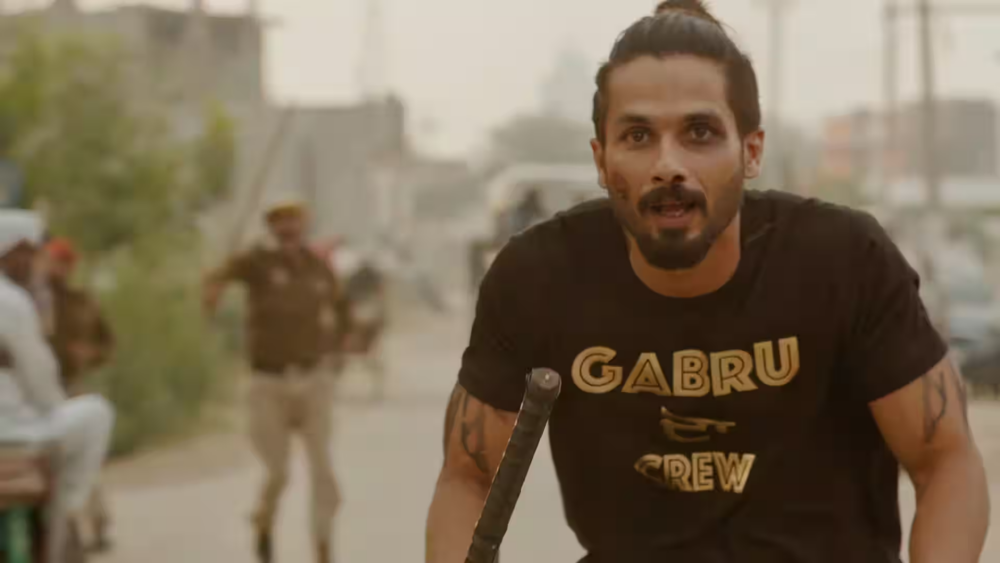
On his birthday, Tommy, we learn, is already past his expiry date. Shahid Kapoor turns in one of the best performances of his career, playing a fading star with hollow eyes. I still can’t get over how good he is in the scene where he looks at his reflection in the toilet mirror and asks, “Who’s the Gabru? I’m Gabru,” moments before he’s busted by the cops.
The Government is happy with soft targets like Tommy Singh. Arrest the celebrity, hold a press conference and pretend you’re winning the war on drugs.
In the other track, Alia’s character realises what she’s found is worth a fortune. When she tries to sell it through Balli, their worlds begin to collide, especially once Balli overdoses.
I’m going to let you rediscover how these threads come together and not ruin it in case you no longer remember the specifics. But it’s a joy to watch the craft with which director Abhishek Chaubey makes the characters travel towards each other—sometimes following them with a Steadicam and sometimes using song montages with long takes to chart those journeys.
I particularly love that shot where Alia’s face lights up once she figures out how much she can sell the drugs for, cutting straight to Tommy sobering up in a prison cell. Long before they meet, the film tells us that their paths are going to cross.
In the other track, Sartaj and Dr. Preet have a conversation as Sartaj realises that the same ₹50 cocktail drug bottle he allowed into the State had found its way to his own brother, almost killing him. By looking the other way, he’d become part of the problem.
But what do you do when most MLAs are narco dealers and the opium used to make these cocktail drugs is sold through licensed pharma companies—or illegally smuggled out by workers who then supply fake companies backed by political players?
I loved the bit when Dr. Preet hesitates to join the investigation.
“But I’m a doctor… a lady.”
And Sartaj replies:
“All the men are drugged out. Only the lady has to do something.”
There are no easy solutions to the war on drugs, they realise. They can expose the system, but the real war is internal—one that addicts need to fight for themselves.
We explore addiction in Udta Punjab from three very different addict perspectives.
Tommy is a has-been rock star, a prisoner of his own image. His audience doesn’t want him lecturing them against drugs. He’s vulnerable, susceptible to relapse under the slightest excuse despite finally being terrified of what drugs have turned him into.
Balli is hooked on cheap and far more dangerous cocktail drugs—the kind you can buy for fifty bucks across the counter. He’s aggressive and violent while battling withdrawal and is effectively imprisoned during rehabilitation.
And finally there’s the kudi jidaan naam Mohabbat—forced into drugs for days and literally imprisoned to be used for sex until the money she supposedly owes is recovered.

With three different kinds of drugs Cocaine, Cocktail drugs & heroin, different reasons for addiction and three different backgrounds – rich, middle class and poor, there’s no one single solution.
And we understand, from Sartaj’s perspective, that for Punjab to win, these three need to break free.
All three of them do break free, but with completely unexpected consequences, one of which is devastatingly heartbreaking.
Though I must admit, it was funny when two people on the run find each other and begin a conversation with: “Do you have stuff?”
I also love the restraint in the film when she shares what happened to her simply by kissing him and saying: “Everything but this.”
Later, when Tommy asks her for a suicide pact given how bleak their lives have become, she snaps back: “Don’t put such ideas in my head.”
As she walks away and Tommy gets beaten up, she returns swinging a hockey stick as Ik Kudi kicks in.
Goosebumps.
Punjab had failed her. But she was still standing there with a hockey stick, fighting the good fight to save Tommy.

Now this is not an easy fight to win without a fair bit of suspension of disbelief, given everything these characters have gone through. A story with no realistic solutions?
One would think so.
Until we learn that the kudi jidaan naam Mohabbat introduces herself as Mary Jane.
That’s when it hit me.
Ten years ago, I thought it was weird that a film about the war on drugs seemed to glamourise another drug. Today, with the legalisation debate becoming far more mainstream, I wonder if Chaubey was asking a different question altogether.
What if we’d spent decades locking up the wrong drug (since 1985 when it was declared illegal under US pressure) just to sell hard drugs that were actually destroying Punjab?
Suddenly, the love story made sense to me.
Abhishek Chaubey was right. Set Mary Jane free.
Where to Watch: Prime Video
Director: Abhishek Chaubey | Writer: Sudip Sharma | Cast: Shahid Kapoor, Alia Bhatt, Diljit Dosanjh, Kareena Kapoor Khan | Runtime: 2 hours 28 minutes

3 thoughts on “Udta Punjab at 10: I think I finally understood the love story”
Comments are closed.