
(This article was first published in June 2022 and has been updated to include analysis of Seasons 2 and 3). Frequently touted as one of the most groundbreaking and visually ambitious shows in recent television history, Euphoria is an instantly recognisable visual phenomenon. It has spawned looks and an associated aesthetic that is wildly expressive, often bordering on surreal. Log into any social media platform and you will likely see users creating their own version of this look and feel. So, what is it about the visual language of the show that makes it so ubiquitous?
Narrated by protagonist Rue Bennett, a drug-addicted teenager in Seasons 1 and 2, the series frequently veers off the mode of realism and makes references to era-defining film and television. Together, the effect is such that the viewer is never quite sure what world Euphoria exists in. But what a truly surreal, surreptitious world it is. Populated with bright flashes of blues and purples and smooth camera movements, there is never a dull moment. And then Season 3 arrived, and changed everything again.
Let’s take a look at what makes Sam Levinson’s Euphoria one of the most daring shows in television history from a cinematography standpoint, and how its visual language has evolved across all three seasons.
Emotional Realism: The Highs and Lows of Teen Life
Show creator Sam Levinson and cinematographer Marcell Rév—a member of both the American Society of Cinematographers (ASC) and the Hungarian Creative Artists Association (HCA)—have said that they were interested in creating a world that prioritised feeling over reality. What this meant was that the camerawork, tone and texture of the footage did not necessarily have to approach realism. There are already many stories and narratives that dealt with triggering topics like drug abuse, body image issues, self-harm and sexual assault through a dark and gritty lens.
Where Euphoria differed was that it employed a visual language that dealt with these topics in the abstract. It was communicating cause, effect and impact in emotive visual language, and not necessarily a linear narrative that imitated reality. Thus, without lessening their impact, the series would often try to show the inner lives of a character in a way that had less to do with what was actually happening, and more with how the character, and by extension, the audience, was feeling. Rév has said:
“It’s not really based on realism. We called it ‘emotional realism’ that’s more based in the characters’ emotions, and not how the world surrounding them really looks. So, that was his (Levinson’s) brief, basically, and then we’ve gone from there and developed a vision, technically.”
“It has to be colorful in a way, I think, to feel that elevation. But we didn’t want it to go like rainbow colors, or with no real system in it. So, most of the time, we’re using primary colors, and I’m relying a lot on the orange-blue color contrast, which is a really basic one.”
So, this is where the signature rapid pans, montages, and bright lights of Euphoria serve their function. They aren’t merely used for a stylistic effect, rather, they help its narrative stand out from similar genres. This also helps the show subvert a subconscious assumption that self-professed dark or serious subject matter can only be told via the visual and cinematic lens of realism.

Rév has even said that the frames of Euphoria look “the way that characters imagine themselves to be.” So, the vibrant, expressionistic mode of storytelling is very much a result of creating a wholly immersive experience, and not the opposite.
Look at one of its earliest opening montages that delineate the backstory of the protagonist. As Rue narrates the great loves and losses of her life, leading up to her drug abuse problem, moments from her life are set to a montage that utilise plenty of mood lighting, whip pans, and long takes. This overtly stylised, technically complex sequence may feel a tad bit too much for a simple narration, yet it is key to building expectation and establishing the tone of the story.
Similarly, the other characters are introduced via montages that use a signature color pattern, or mood lighting to associate a set of emotions with the narrative. While Cassie Howard’s inner life is set to the pale tones of blues and cool whites to denote her loneliness, Jules Vaughn is often represented in shades of pinks, purples and vibrant magenta to signify her journey of gender identity and femininity.
Color, Lighting, and Subtext
A Euphoria-centric aesthetic, if it can be called that, is sheer magnificence. Populated with mood lighting, neon highlights and varied hues of blue, pink and purple, it contributes to a rarified ethos of tasteful maximalism in film and television. One that’s become increasingly rare, if I may say so. One may wonder, if it actually serves the story, or if it is all a stylistic choice?
The short answer: yes, and yes. While the use of signature colors and striking lighting undoubtedly set it apart from contemporary teen dramas on television, they also serve to elevate the story that it ultimately seeks to tell. We already discussed how Levinson and Rév tried to centre the feelings invoked in the characters and audience due to the occurrence of certain events in the plot, instead of the events themselves.
This plays out in a manner where the light and color help the audience navigate the emotional landscape of the character. The effect is as if they’ve entered a fever dream, and what a dream it truly is.
For example, when it comes to Nate Jacobs, grays and dull blues take over the frame. This hints towards his lack of warmth and feeling, and keeps us on our toes regarding his sinister intentions. Contrast this with the distinct, warm hues of orange, reds and pinks associated with a character like Jules. When these two finally confront each other, the blue-orange contrast that Rév mentions is on full display.

It is also important to note that Rév drew lighting from practical sources on each set, rather than supplementing heavily with additional units. Existing lamps, neon signs, phone screens, overhead fluorescents. This approach not only grounded the heightened color palette in physical reality but gave the operating team greater freedom of movement, since the exposure was determined by the environment rather than a rigged lighting plan.
Combined with the long tracking shots and dynamic camera movement, the show builds up an ambience that draws the viewer into the world of the character. Consider the scene from Season 2, Episode 1, where Maddy unknowingly bangs on the restroom door while her friend Cassie has s** with her ex-boyfriend Nate on the other side. The camera follows her as she rapidly walks down the hallway, gradually pushing closer and closer. Shots like this reinforce the feelings of dread, anxiety and the constant fear of being found out that accompany much of teenage life.
Season 1 to Season 2: From Digital to Film
One of the most significant, and least discussed, technical shifts occurred between Seasons 1 and 2. Season 1 was shot digitally, using carefully manufactured haze and post-production tools to soften edges and create the signature neon glow.
Season 2 was a dramatic departure. Rév and Levinson switched to Ektachrome film stock on 35mm, a stock that was largely discontinued and had to be revived specifically for the production. Kodak agreed to bring back Ektachrome only after the Euphoria team committed to shooting more than one million feet of the stock.
The reason to switch from film to digital was conceptual. Levinson wanted Season 2 to feel like “a fading photograph that can disappear at any time.” A visual metaphor for the fragility and impermanence of the characters’ lives. The grain, the slightly muted contrast, the particular way Ektachrome renders skin tones all contributed to a season that felt both more intimate and elegiac than its predecessor.
The shift also changed the practical conditions of shooting. The show became more tactile, more dependent on physical light sources and practical environments. The stage-bound approach of Season 2, where roughly 80% of the production was built on soundstages, gave Rév extraordinary control over every light source in the frame.
Cinematic References
Euphoria is a show which is very much informed by the cultural references of the moment. The show’s heavy involvement in creative imagery, coupled with the symbolism and vivid style, makes it rife with references. It’s apparent that every artistic comparison shown is deliberate, whether through vibrant color palettes or cultural comparisons via the lens of Hollywood blockbusters. Be it in terms of story, theme or genre, nothing is an accident.
Sam Levinson has made it clear that he draws creative inspiration from other forms of art and pays homage to them through the programme.
This montage of Rue and Jules from Season 2, referencing famous couples across film and art—The Birth of Venus by Botticelli, Ghost, Brokeback Mountain, Titanic—is perhaps the best example. Other examples abound, such as Nate’s morning ritual, where he immerses his head in water and comes back up, referencing the French film La Haine. This hints at his troubled, at times violent and hate-filled relationship with masculinity. Another such instance is Rue’s stumbling drug stupor at a party, which cheekily evokes a visual connection to Inception, an iconic narrative about altered realities.
With characters frequently dressing up like iconic personas from films (Cassie as Alabama Worley from True Romance, Jules and Rue as the titular pair from Romeo & Juliet), the idea is to present a meta narrative that counts on visual associations borne from years of pop culture and cinema to evoke a certain feeling in the audience.
‘Evolve or Die’: Birth of Kodak Verita 200D in Season 3
If Season 1 was a neon fever dream and Season 2 a fading photograph, Season 3 of Euphoria is a sun-drenched, wide-screen vision of the American West that has more in common with classical Hollywood epics than anything the show had previously attempted.
Our approach has always been, “Evolve or die. And whatever we’ve done, we’re not interested in doing it again,” Levinson said when Euphoria Season 3 premiered on April 12, 2026.
The visual reinvention began with film stock. Rév and Levinson worked directly with Kodak’s engineers to develop an entirely new motion picture film stock, Kodak VERITA 200D 5206/7206, specifically for Season 3. The stock, now commercially available in 16mm, 35mm, and 65mm formats, was developed after Rév began experimenting with existing still photography stocks, processing them through different motion picture developing methods on his personal Leica M1 and Contax T3 cameras. The experiments led to VERITA 200D: a medium-speed, daylight-balanced film stock designed to deliver bold colors, detailed highlights, warm natural skin tones, and exceptionally rich dynamic range.

The production shot daylight exteriors and interiors on VERITA 200D in 65mm, a format rarely seen in television production, while night interiors and most night exteriors were shot on KODAK VISION3 500T Color Negative Film 5219, which offered greater sensitivity in tungsten-balanced environments. The 65mm format was shot in a 2.20:1 aspect ratio, significantly wider than standard television framing, giving the season an operatic, cinematic scale that physically reflects the characters’ transition from the closed world of high school into the wider, more dangerous adult world.
Euphoria Season 3 is one of the first narrative TV series to shoot significant volumes of large-format 65mm film. The decision to shoot in 65mm wasn’t merely aesthetic, it was thematic. As Levinson said:
“We’re leaving high school and wanted to explore what the wider world looked like.”
The influence of Old Hollywood, epic landscapes, characters small against an indifferent world, and a storytelling perspective less subjective than in the first two seasons all shaped the choice of format.
Production designer François Audouy, who built the season’s color palette in close collaboration with Rév, drew inspiration from Kodachrome photography, favouring “orangey reds, pale blues and yellows” designed to interact with VERITA 200D’s bold color saturation. Season 1’s neon pinks and purples are gone, replaced by the sun-bleached palette of California and old Westerns.
Season 3: The Border Wall Sequence

The opening sequence of Season 3 Episode 1 (“Ándale”) is the single most technically audacious scene in Euphoria and a masterclass in physical filmmaking. And it was inspired by a chance discovery.
During a research visit to the Drug Enforcement Administration (DEA) headquarters in Los Angeles, Levinson spotted a photograph on the wall: a Jeep, seized during a drug bust, stuck on top of a border wall, driven there by someone who had attempted to cross into the United States with a car full of cocaine. “I said, ‘Well, what happened here?'” Levinson recalled. The answer became the season’s opening image.
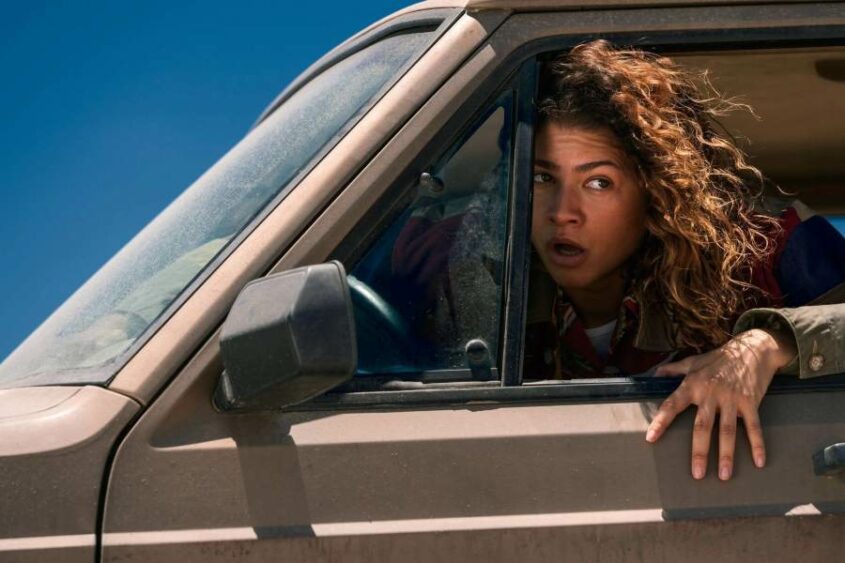
In the scene, Rue, who’s five years out of high school, relatively sober, but still paying off a debt to her dealer Laurie by smuggling fentanyl, attempts to drive her car over the U.S.-Mexico border wall using a makeshift ramp. The car crests the wall and gets stuck. Rue is left teetering 20 to 25 feet in the air, suspended between two countries, going nowhere.
The production could not use the real border wall. Instead, Audouy built a 200-foot replica in the high desert four hours outside LA, in a desolate location that replicated the vast, empty expanse of the actual border region. VFX supervisor Mark R. Byers designed a hydraulic system capable of tilting the car forward and backward at real height, allowing Zendaya to perform inside it. A five-foot replica was constructed for close-up shots, but the wide shots, which are the sequence’s most powerful images, were achieved practically, with Zendaya genuinely elevated above the desert floor.
The sequence was shot on 65mm VERITA 200D, and the format choice is immediately visible. Where earlier seasons would have favoured tight close-ups of Zendaya’s face, here Rév pulls back to a wide shot that makes Rue look like a toy figurine against the immensity of the desert landscape. It is an image of smallness and precariousness that no amount of neon lighting could have achieved.
The biggest practical challenge was the sun. Rév had to maintain the sun at a specific angle throughout the shoot, making strategic decisions about when to capture wide shots versus close-ups based on the light’s position, fighting the elements in a way that the stage-bound Season 2 never required.
Levinson and Rév described the sequence as “Jurassic Park meets Buster Keaton,” a precise comparison. Like the Jeep-in-the-trees scene from Spielberg’s film, and like Keaton’s physical comedy performed at genuine risk, the scene is simultaneously funny and frightening. As Levinson said:
“It highlights the humor of this season and the tension of it, and they’re working in tandem.”
Wrapping Up
The shift in Season 3 goes beyond film stock and aspect ratio. In Seasons 1 and 2, the cinematography was subjective. It communicated inner states through expressionistic color, tight framing, and a camera that moved with the anxiety and desire of its characters. The show was, in Levinson’s words, about “how Gen Z teenagers imagined themselves, rather than how they appeared from the outside.”
Season 3 inverts this. Set five years after Season 2, with the characters now navigating adult life in Southern California, the camera steps back. Wide shots replace close-ups. The epic landscape of the American West replaces the claustrophobic interiors of East Highland. The cinematography’s new job is not to express interiority but to expose it; to show characters who are small in a world that is very large, whose personal mythologies are dwarfed by the indifferent scale of the real.
Levinson has cited influences including Howard Hawks, Sergio Leone, and the classical Western—filmmakers for whom landscape was itself a form of moral argument. The influence of The Idol, the HBO series Levinson and Rév made between Euphoria seasons, was also significant. “The way that I saw it was almost like I was filming a reality TV show at times—three cameras, minimal lighting, almost documentary style,” Levinson said. The objectivity and restraint developed on The Idol fed directly into Season 3’s more distanced, observational visual style.
Euphoria concluded on May 31, 2026, with Season 3 confirmed by HBO as the series finale.
Across three seasons and three entirely different visual philosophies, the camera remained the argument. It just kept changing what it was arguing for.
Where to Watch Euphoria (2019-2026): JioHotstar, Prime Video
(Additional writing by Mitch Farrell)
